A VAT receipt is proof of purchase that shows VAT (Value Added Tax) was charged on a sale, broken out separately from the price of the goods or services. It’s different from an ordinary receipt because it must show the seller’s VAT registration number, the VAT rate applied, and the VAT amount on its own line — details a regular receipt has no obligation to include.
This is general information, not tax advice. VAT rules, thresholds and formats are set by tax authorities like HMRC and change periodically — always confirm current requirements at gov.uk or with an accountant before relying on this for compliance or reclaiming VAT.
VAT Receipt vs. Regular Receipt vs. VAT Invoice
These three terms get used almost interchangeably in everyday conversation, which is exactly why so many people search for a plain answer. Here’s the actual difference:
| Document | Shows VAT separately? | Who issues it | Typical use |
|---|---|---|---|
| Regular receipt | No (unless the seller chooses to) | Any seller | Basic proof of payment |
| VAT receipt | Yes — VAT amount and rate shown | VAT-registered sellers only | Retail purchases where the buyer may need to reclaim VAT |
| VAT invoice | Yes, plus more required fields | VAT-registered sellers, usually for B2B sales | Business-to-business transactions, larger or credit sales |
In practice, “VAT receipt” and “VAT invoice” are often used to mean the same thing, and HMRC itself treats a simplified VAT invoice as the standard VAT receipt you’d get from a shop, café or petrol station. The real dividing line isn’t the name on the document — it’s whether VAT is registered, charged and shown as its own line item. If you’re unsure how a receipt differs from an invoice more generally, our guide on receipts vs. invoices covers the non-VAT basics.
Why a VAT Receipt Matters
A VAT receipt does two jobs at once. For the customer, it’s the only evidence that lets a VAT-registered business reclaim the VAT it paid on a purchase — no valid VAT receipt generally means no VAT reclaim, whatever the circumstances. For the seller, issuing a compliant VAT receipt is a legal record-keeping obligation, not an optional nicety: it’s what a business shows a tax authority if its VAT return is ever queried.
That second point is worth sitting with for a moment. A missing VAT number, a VAT amount that isn’t shown separately, or a receipt copy that was never retained can turn a routine VAT inspection into a genuinely stressful conversation. The good news is that none of this requires expensive software — it just requires knowing which fields have to be on the document, every time, without exception.
Which VAT Rate Should Show on the Receipt?
The VAT rate printed on a receipt isn’t a single fixed number — it depends on what was actually sold, and getting it wrong is one of the more common issuing mistakes. In the UK, goods and services generally fall into one of three bands:
- Standard rate (20%) — the default rate that applies to most goods and services unless a specific exception applies
- Reduced rate (5%) — used for a shorter list of items, such as domestic energy in some circumstances
- Zero-rated (0%) — VAT is technically charged, just at 0%, and still needs to appear as its own line for items like most food, children’s clothing and books
A receipt showing the wrong band for what was actually sold is still a compliance error even if the total charged happens to be correct — the rate itself is part of what makes the document valid. If a single sale mixes items from different VAT bands (a supermarket receipt with both standard-rated and zero-rated items is the classic example), each rate should be broken out separately rather than averaged into one figure.
What Has to Be on a Valid VAT Receipt
Tax authorities generally recognize two formats, and which one applies depends on the value and type of the sale.
Simplified VAT receipt
This is the version most people actually hand over — the kind printed at a till in a shop, café or restaurant. In the UK, it’s permitted for retail sales up to £250 (always check gov.uk for the current figure, since thresholds are reviewed periodically) and needs to show:
- The seller’s name, address and VAT registration number
- The date of the sale
- A description of the goods or services
- The total price including VAT
- The VAT rate that applied (standard, reduced or zero-rated)
Full VAT invoice
Required for most business-to-business sales, higher-value transactions, and whenever the buyer specifically asks for one. It needs everything a simplified receipt has, plus the buyer’s name and address, a unique sequential invoice number, the quantity of each item, and the price shown excluding VAT before the VAT amount is added on as its own line.
For a full field-by-field breakdown of UK requirements — including the exact wording HMRC expects and the most common compliance mistakes — see our dedicated guide: VAT Receipts in the UK: What Every Business Must Include. VAT (or an equivalent consumption tax like GST) isn’t unique to the UK — most of the EU, and many countries outside it, run a similar system, though the exact fields and thresholds differ by country. If you’re issuing receipts outside the UK, our roundup of receipt legal requirements by country is a good next stop.
A Worked Example
Numbers make this concrete faster than definitions do. Here’s a simplified VAT receipt for a small café sale — two flat whites and a panini, VAT charged at the UK standard rate of 20%:
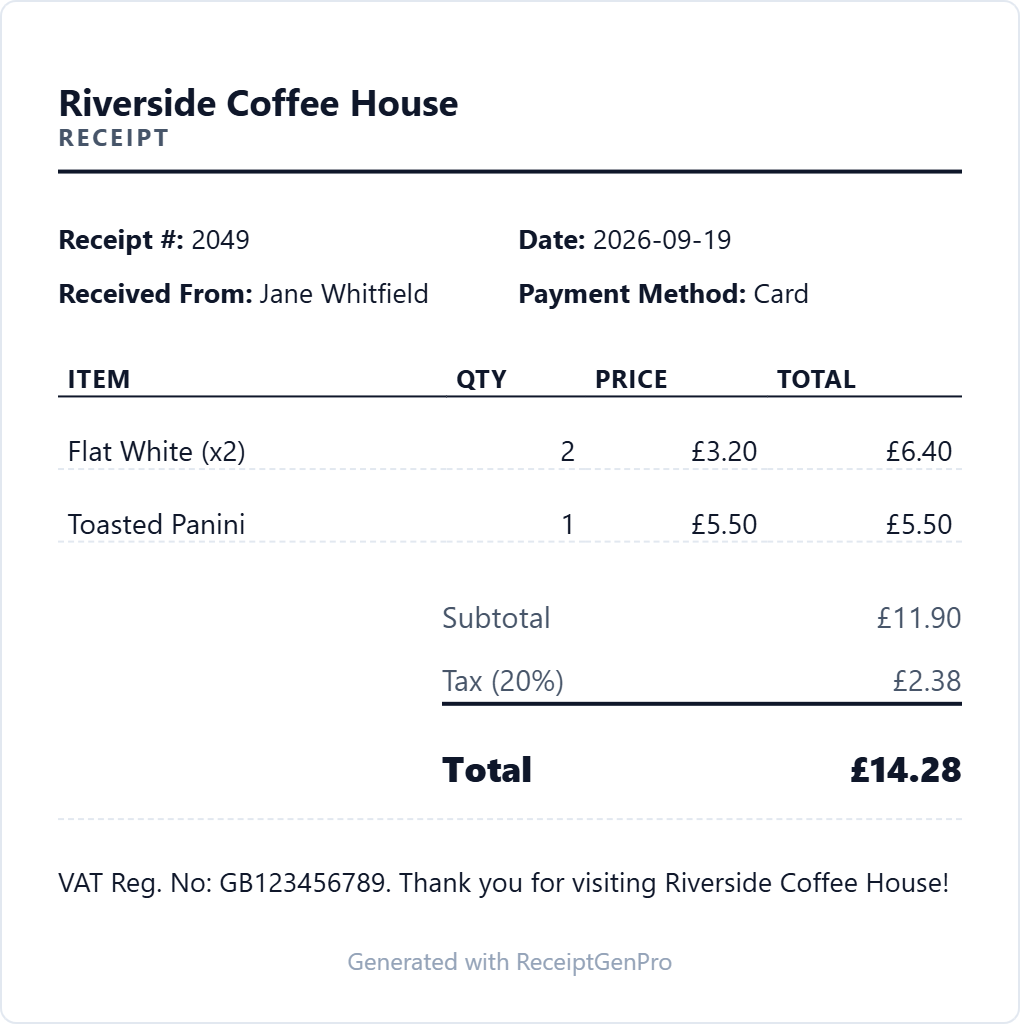
Notice what’s happening in the totals: the £11.90 subtotal is the price of the goods before tax, the 20% VAT works out to £2.38, and the two are added together for a £14.28 total. That separation — subtotal, VAT amount, and final total each shown on their own line — is the single detail that turns an ordinary till receipt into a valid VAT receipt. A receipt that only shows “£14.28 total, VAT included” without breaking out the £2.38 doesn’t meet the requirement, even though the customer paid the correct amount either way.
How to Create a VAT-Compliant Receipt in Under a Minute
You don’t need accounting software to issue a correct VAT receipt — the itemized fields our free receipt generator already asks for map directly onto what a simplified VAT receipt needs. Here’s the actual workflow:
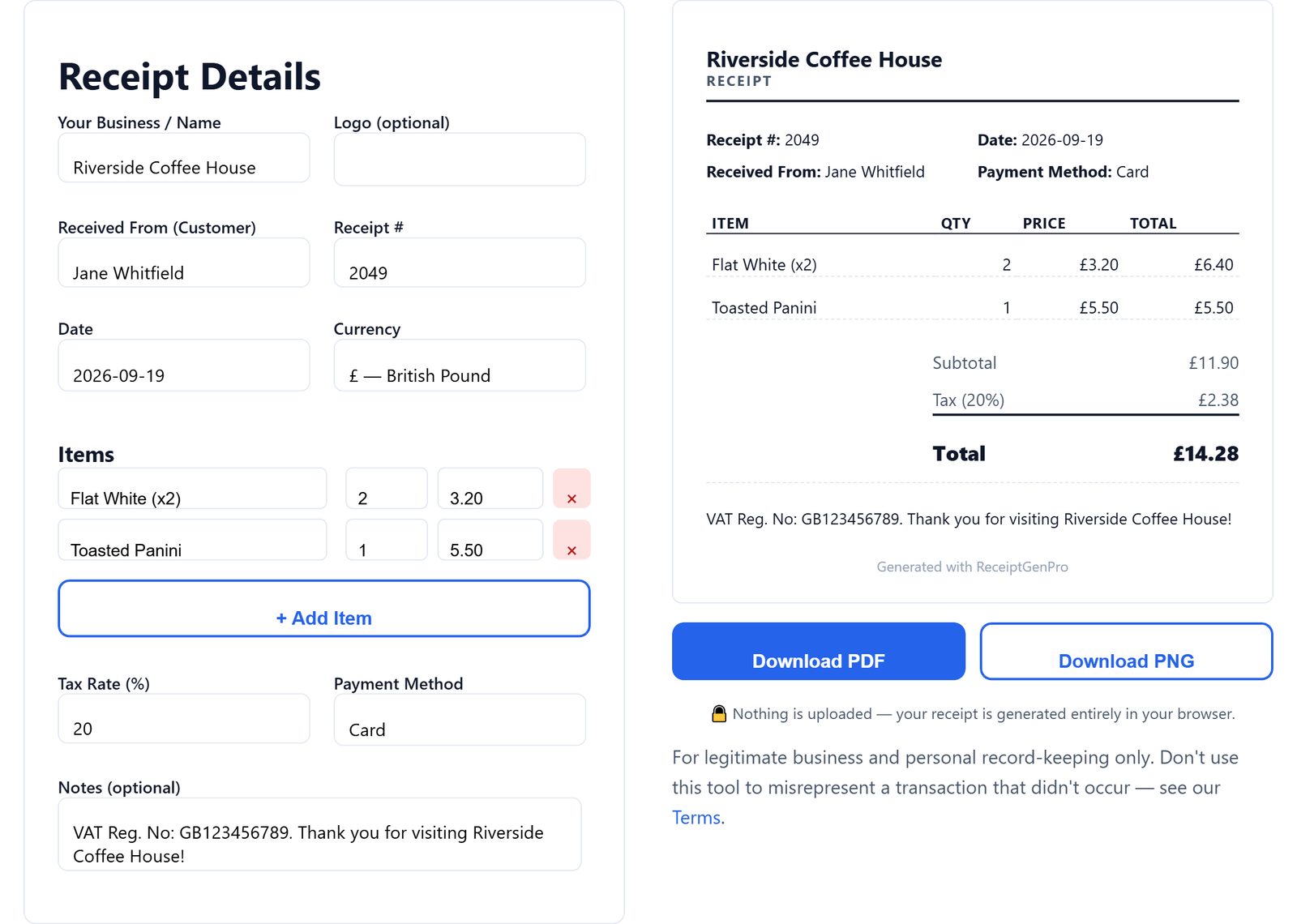
- Add your business name and, in the notes field, your VAT registration number (for example, “VAT Reg. No: GB123456789”) — there’s no dedicated VAT-number field, so the notes box is the right place for it.
- List each item separately with its quantity and price, rather than lumping everything into one line — this is what lets the tax breakdown calculate correctly and gives the buyer a proper description of what they bought.
- Set the tax rate to the VAT rate that applies to the sale — 20% for most standard-rated goods and services in the UK, or whatever rate is correct for your country and category.
- Check the live preview on the right to confirm the subtotal, tax amount and total are all shown as separate lines, exactly as required — it updates instantly as you type.
- Download it as a PDF, PNG or JPEG and hand it to the customer, or print it directly from the browser.
Everything runs in your browser — nothing is uploaded to a server, which matters for a document that often contains a customer’s name and a business’s VAT number. Our restaurant receipt and cash receipt templates use this same itemized layout if you’d rather start from a template already set up for a specific business type.
Can You Claim VAT Back Without a Receipt?
This is one of the most common follow-up questions, usually asked after the receipt is already lost. The honest answer: it’s difficult, but not always impossible.
HMRC’s default position is that you need a valid VAT invoice or receipt to reclaim input VAT — it’s the primary evidence that VAT was actually charged. Without one, a business generally can’t reclaim the VAT on that purchase through its VAT return. That said, a few things can sometimes help in place of the original:
- A duplicate or reprinted receipt from the retailer — many tills can reprint a recent transaction if you know the date and roughly what you bought
- A bank or card statement showing the transaction, though this alone rarely satisfies HMRC on its own since it doesn’t show the VAT breakdown
- An email or digital receipt, if the seller issued one — this counts as a valid record just as much as a paper one
None of these are guaranteed to work, and HMRC ultimately decides what evidence it will accept on a case-by-case basis. The practical lesson is the one nobody enjoys hearing: photograph or file every VAT receipt the moment you get it, because chasing a replacement afterward is far harder than keeping the original in the first place.
Are Digital VAT Receipts Valid?
Yes. A digital VAT receipt — a PDF, an emailed copy, or one generated and downloaded straight from a browser — is just as valid as a paper one, provided it contains every field a paper VAT receipt would need. HMRC’s Making Tax Digital rules were built around exactly this shift: digital records are not just accepted, they’re increasingly the expectation. The one rule that doesn’t change between paper and digital is retention — VAT records generally need to be kept for several years, so a digital copy actually has the advantage of being easier to search, back up and produce on demand than a shoebox of fading paper.
Common Mistakes to Avoid
- Showing VAT without being VAT-registered. Only a VAT-registered business can legally add a VAT line to a receipt — doing it otherwise isn’t just a formatting error, it’s not permitted.
- Rounding the VAT amount into the total. “£14.28, VAT included” isn’t the same as showing £11.90 + £2.38 = £14.28 as separate figures — the breakdown is the part that makes it a VAT receipt.
- Issuing a simplified receipt for a sale that needs a full invoice. Higher-value and B2B sales usually call for the full format, buyer details included.
- Throwing away the seller’s copy. The obligation to retain VAT records applies to the business issuing the receipt, not just the customer receiving it.
For the complete, UK-specific compliance checklist and a longer list of mistakes businesses actually make, see VAT Receipts in the UK: What Every Business Must Include.
Is a VAT receipt the same as a VAT invoice?
Close enough in everyday use that the terms are often swapped freely. Technically, a simplified VAT invoice is what most people mean by “VAT receipt” — a shorter document for retail sales — while “VAT invoice” more often refers to the fuller format used for B2B and higher-value transactions.
Do I need a VAT receipt for every purchase?
Only if you plan to reclaim the VAT, or the seller is VAT-registered and required to issue one. For everyday personal spending with no VAT reclaim involved, a regular receipt is enough.
What if my VAT receipt doesn’t show a VAT number?
Then it isn’t a valid VAT receipt, even if VAT was technically charged. Ask the seller for a corrected copy — without the VAT registration number, the document generally won’t be accepted for a VAT reclaim.
Can I create a VAT receipt for my small business for free?
Yes. Our receipt generator is free, requires no signup, and lets you add a VAT-registered business’s details, itemized goods or services, and a tax rate line — everything a simplified VAT receipt needs — then download the result as a PDF, PNG or JPEG.
Is a VAT receipt required for expense claims?
For VAT-registered businesses reclaiming input VAT specifically, yes — a valid VAT receipt is the standard evidence required. For general expense claims that don’t involve reclaiming VAT, company policy usually just asks for any receipt showing what was bought and how much was paid.
Can you claim VAT on supermarket receipts?
Only for business purchases, and only on items that carried VAT. Most food is zero-rated in the UK, so a supermarket receipt often shows VAT on just a few lines, such as cleaning products or stationery. Keep the till receipt: if it shows the store's VAT number and the VAT for each rate, it works as a simplified VAT invoice for purchases of £250 or less.
Where is the VAT number on a receipt?
Usually under the seller's name and address at the top, or in the footer, labelled "VAT No." or "VAT Reg No." A UK VAT number starts with GB followed by 9 digits. No VAT number means the receipt can't be used to reclaim VAT.
How long should you keep VAT receipts?
In the UK, HMRC asks VAT-registered businesses to keep VAT records, including the receipts and invoices behind them, for at least 6 years. Other countries set their own periods; see our guide to how long to keep business receipts.